Flood history
Has this house flooded before? How to check a property’s flood history
You can’t type an address into a government website and see whether the house has flooded. But between the seller, a handful of public flood records, and the land itself, a buyer can usually get a clear picture before closing.
FEMA’s flood insurance claims for a specific address are private, and only the current owner can request them. So: ask the seller for the disclosure form, the property’s flood-loss history from FEMA and an insurance claims (CLUE) report; check the public record for the area, which shows which storms flooded it and when; and read the land: the flood zone, low spots and drainage paths around the lot.
What isn’t public, and why
Most flood insurance in the U.S. is written through FEMA’s National Flood Insurance Program (NFIP). Its records on individual policies and claims are protected under the Privacy Act. FloodSmart, the NFIP’s public site, says prospective buyers can’t get a property’s past claim information under current federal law.
What FEMA does publish is every NFIP claim since 1978 without names or addresses: the year and date of loss, ZIP code, census block group, flood zone and amount paid. Coordinates are rounded to one decimal place, roughly six miles. That’s enough to see when and how often an area has flooded, but never a single house.
Ask the seller for these four things
The person who can unlock a property’s own flood history is its current owner. Put these requests in writing, ideally with your agent, before your option or inspection period ends.
| Ask for | What it shows | Limits |
|---|---|---|
| Seller’s disclosure | In states that require it, the seller’s answers about past flooding, flood insurance claims and disaster aid. | Many states don’t require flood questions at all. |
| NFIP flood-loss history | The dates and dollar amounts of past NFIP claim payments on the property, including from before the current owner bought it. | Only the current owner can request it from FEMA. Covers NFIP-insured losses only. |
| CLUE report | Up to seven years of home insurance claims on the property (LexisNexis). Verisk’s A-PLUS report is similar. | Owner only; one free report a year. May not include NFIP flood claims. |
| Flood insurance and Elevation Certificate | Whether the house is insured for flood, what it costs, and how high the building sits relative to the base flood elevation. | Not every house has an Elevation Certificate. |
Seller disclosure laws vary by state
There is no federal law requiring sellers to disclose past flooding. A growing number of states do, for example:
- Texas (since September 2019): the seller’s disclosure notice asks about previous flooding, flood insurance claims with any insurer including the NFIP, and FEMA or SBA flood assistance.
- New York (since March 2024): sellers can no longer skip the disclosure form with a $500 credit, and it now covers flood history, flood insurance claims and federal assistance.
- Florida (since October 2024, expanded October 2025): sellers must disclose flood insurance claims and federal flood assistance, and now flood damage during their ownership, at or before signing the contract.
- North Carolina (since July 2024): the disclosure form has flood questions, but sellers may answer “No Representation,” so a blank answer tells you nothing.
- South Carolina and Louisiana also ask about flooding on their disclosure forms.
For your state, check NRDC’s flood disclosure map and ask your agent which form applies. Even where disclosure is required, a seller may not know about flooding before they owned the house, which is why the FEMA loss history is worth asking for.
How the seller gets the FEMA flood-loss history
The owner sends the NFIP a signed request with a statement of ownership. Many county floodplain offices hand out FEMA’s request letter, and the NFIP’s data FAQ explains the process. FEMA’s privacy rules allow it to give current owners the dates and dollar amounts of past loss payments on their property.
A clean CLUE report isn’t proof the house never flooded. Standard homeowners policies don’t cover flooding, flood claims usually go through the NFIP instead, and many flooded homes had no flood insurance at all.
Check the public record for the area
Public flood records won’t name the house, but they show which storms hit the neighborhood and how hard. Here is what the claims record looks like for one county:
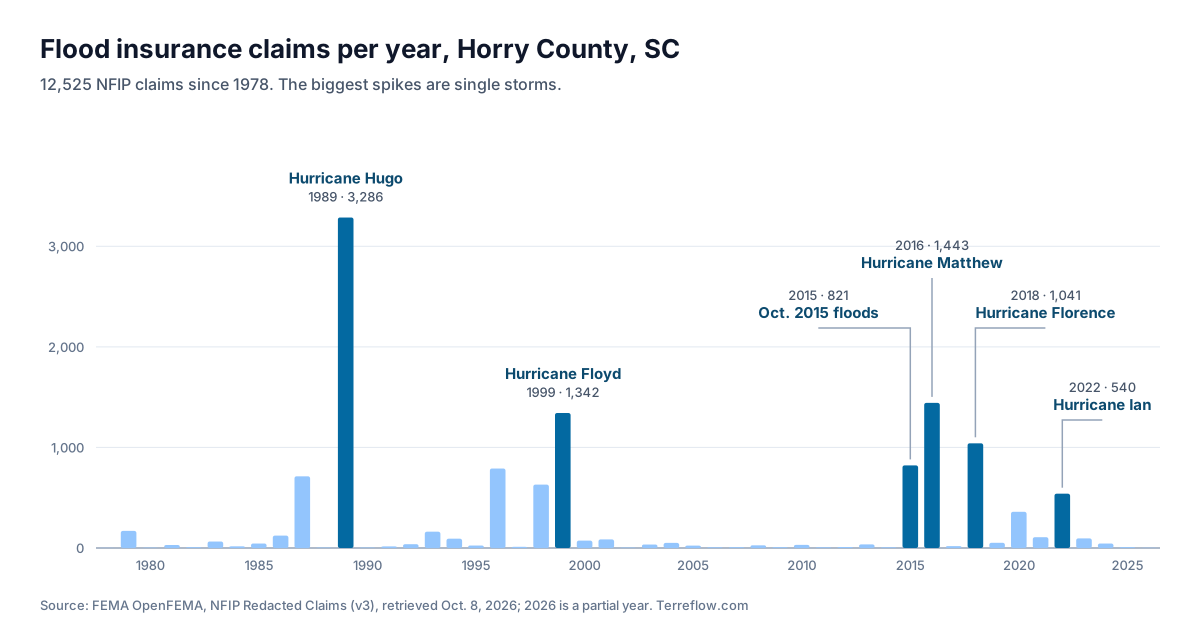
- FEMA flood claims by ZIP code. The OpenFEMA NFIP claims data can be filtered by ZIP code or census block group to show how many claims an area had, in which years, and in which flood zones.
- USGS high-water marks. After major floods and hurricanes, the U.S. Geological Survey surveys how high the water reached. The Flood Event Viewer maps those marks and storm sensors by event.
- Post-storm aerial photos. NOAA flies emergency response imagery after selected hurricanes and floods, often within days. Find the house and look for standing water, debris lines or tarps.
- Historical satellite imagery. Google Earth’s historical imagery (the clock icon in Google Earth Pro, and now on the web) lets you step back through older photos, sometimes taken right after a flood.
- NOAA Storm Events Database. The National Weather Service record of floods and flash floods by county, with full flood coverage from 1996.
- FEMA Flood Insurance Study. The study behind the local flood map, downloadable from the Map Service Center, often describes the community’s historic floods.
- The neighbors and the county. Ask next-door owners how the street did in the last big storm. County or city stormwater offices can tell you about known problem areas and drainage complaints, though not individual insurance claims.
Read the land and the house
A house that has never flooded can still sit where water collects. Check the FEMA flood zone (see Is my house in a flood zone?), and look at the terrain: is the lot lower than the street, at the foot of a slope, or in the path of a drainage line? Our terrain checklist covers what to look for.
At the showing or inspection, look for physical signs of past water:
- water lines or staining on walls, fences, the foundation or the water heater;
- new drywall, baseboards or flooring only on the lowest floor or the bottom few feet of walls;
- a musty smell, mold, or a dehumidifier running in a basement or crawlspace;
- rust on the bottom of appliances and HVAC equipment, or silt in the crawlspace;
- a sump pump, French drain or fresh grading, and ask why it was installed.
See where water goes around a property
Terreflow maps the terrain drainage around an address next to its FEMA flood zone: where rain runs, where it collects, and whether the lot is in its path.
Analyze an address →Sources
- FloodSmart (NFIP), FAQs about NFIP data
- DHS/FEMA-003, National Flood Insurance Program Files system of records, 79 FR 28747 (2014)
- FEMA, OpenFEMA: NFIP Redacted Claims (v3), retrieved October 8, 2026
- Consumer Financial Protection Bureau, LexisNexis CLUE and Verisk A-PLUS
- Texas Legislature, SB 339 (2019), Property Code §5.008; Florida Statutes §689.302
- NRDC, Flood disclosure map
- USGS, Flood Event Viewer; NOAA, Emergency Response Imagery and Storm Events Database